

 inglés
 francés
 español
 ruso
ruso coreano
 Japonés japonés
Say Goodbye to Synthetic Dyes? Marigold-Derived Lutein Offers a Natural Coloring Solution
En hoy y#39;s global food market, a revolution known as “clean labeling” is reshaping the industry's competitive landscape at an unprecedented pace. Consumers are no longer satisfied with taste and flavor alone; they have become ingredient-conscious, scrutinizing every ingredient listed on the back of packaging with a magnifying glass. Authoritative market research reveals that over 76% of consumers consider “free from artificial colors” a key factor in their purchasing decisions, a trend particularly pronounced in children's foods, premium beverages, and health-conscious snacks.
Faced with this wave, food brands confront a critical strategic choice: continue relying on stable, low-cost yet controversial synthetic dyes, risking being labeled “unhealthy”? Or boldly shift to natural alternatives, yet worry about potential new challenges in coloring power, stability, and cost? The answer to this question directly impacts a brand's market credibility and future competitiveness.
It is against this backdrop that a solution combining natural attributes with exceptional performance has emerged—natural marigold-derived lutein. More than a simple pigment replacement, it represents a comprehensive “clean label coloring solution” dedicated to helping brands strike the perfect balance between “eye-catching visual appeal” and “clean labels that win hearts,” thereby seizing the initiative in this industry transformation.
Part One: Why is Marigold Lutein the Ideal Natural Alternative?
When food brands commit to phasing out synthetic colorants, the paramount concern is: Can natural alternatives truly deliver? Luteína extrade caléngolde provides a resounding yes through two core advantages.
1. Pure Origins: The Traceable Journey from Golden Fields to Premium Ingredients
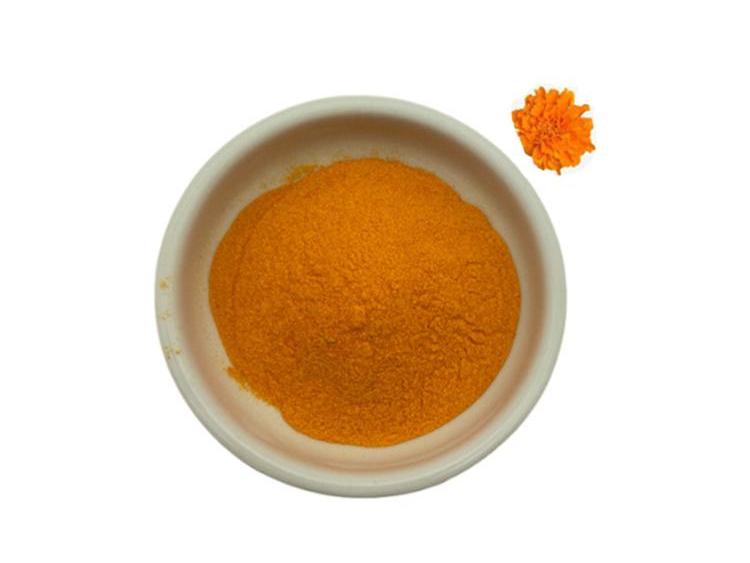
Tagetes erecta, hailed as nature's pigment goldmine, boasts petals rich in concentrated lutein esters. Our end-to-end quality control system—spanning cultivation to extraction—ensures purity and consistency in every batch:
·Selective cultivation bases: Large-scale planting in dedicated regions with abundant sunlight and clean soil guarantees non-GMO and sustainable sourcing from the outset
· Gentle extraction process: Modern techniques like CO₂ supercritical extraction efficiently separate lutein esters at low temperatures, maximizing preservation of natural bioactivity
· Stringent Quality Assurance: Every batch undergoes rigorous safety testing for heavy metals, pesticide residues, and more, meeting standards set by the U.S. FDA, EU EFSA, and China's GB regulations
This comprehensive traceability chain transforms “natural” from a marketing concept into a visible, verifiable, and trustworthy quality guarantee.
2. Performance: Scientific Proof That Natural Doesn't Mean Compromise
Contrary to common perception, specially processed marigold lutein demonstrates performance comparable to or even surpassing synthetic pigments in key metrics:
Exceptional Coloring Power
· Offers a complete spectrum from bright lemon yellow to rich sunset yellow
· High coloring strength requires minimal addition to achieve ideal hues in beverages, confectionery, and other applications
Outstanding Stability Performance
Accelerated test data confirms exceptional color stability under the following conditions:
Test Condition Stability Performance Suitable Applications
pH 3-7 range Color retention rate >90% Beverages, confectionery, dairy products
High-temperature processing (≤130°C) Pigment retention rate >85% Baked goods, confectionery
Continuous light exposure (30 days) Fading rate <5% Transparent packaging products
Broad application compatibility
· Excellent dispersibility in both oil-based and water-based systems
· Compatible with diverse food ingredients, minimizes adverse interactions
Technical Director's Insight: "Choosing marigold lutein isn't settling for a compromise—it's a strategic upgrade meeting both performance and health standards. Through technological innovation, we ensure natural pigments meet modern food industry demands for stability, safety, and cost-effectiveness."
Part Two: How Natural Coloring Solutions Empower Food Innovation
Choosing marigold lutein means acquiring not just a natural pigment, but a strategic solution that creates multiple value dimensions for your brand. Here are its enabling pathways across three key dimensions:
Enabling Pathway 1: Building “Clean Label” Credibility to Earn Market Trust
Core Value
In an era where consumers scrutinize food ingredients more than ever, replacing synthetic colorants like “Tartrazine” or “Sunset Yellow” with “Marigold Extract” or ‘Lutein’ in ingredient lists represents a brand's strongest commitment to “clean, transparent, and natural” values.
Application Examples
· Children's Food: A renowned infant food brand optimized its teething stick ingredients to “wheat flour, marigold extract (coloring),” gaining rapid popularity among mothers for its simplified formula.
· Premium Beverages: A cutting-edge sparkling water brand differentiated itself by highlighting “natural marigold coloring” in its ingredient list, achieving a 20% increase in average transaction value.
Claims available to customers:
“0 synthetic colors,” “derived from natural marigold,” “clean label formulation”
Empowerment Pathway 2: Unlock New Products, Enter High-Growth Tracks
Core Value
Marigold lutein's exceptional stability enables its broad application in innovative foods with demanding processing requirements, helping brands pioneer new growth opportunities.
Application Scenarios Explained
· Beverage Solutions
· Challenge: Color stability in acidic environments and light resistance in transparent packaging.
· Solution: Utilizes specially encapsulated lutein achieving over 95% color retention during shelf life in vitamin-enriched beverages at pH 3.5.
· Confectionery & Ice Cream
· Challenge: Color retention after high-temperature cooking and migration resistance during storage.
· Solution: Delivers exceptional heat stability, ensuring vibrant, uniform color in gummies; effectively prevents color unevenness caused by ice crystal formation in ice cream.
· Bakery & Flour Products
· Challenge: Pigment retention and texture changes during high-temperature baking.
· Solution: Delivers outstanding performance in cake mixes, maintaining an appealing golden hue post-baking without compromising product volume.
Empowerment Path 3: Crafting a “Natural” Brand Story for Differentiation
Core Value
The “marigold” itself embodies a sunny, nature-inspired visual symbol that effortlessly translates into compelling brand narratives. This inherent appeal positions your products with built-in marketing power on retail shelves.
Marketing Entry Points
· Visual Association: Use “golden sunshine from marigolds” as the core visual symbol, integrated throughout product packaging and advertising.
· Educational Marketing: Educate consumers via social media about marigold cultivation and extraction processes, reinforcing the perception of “truly sourced from nature.”
· Emotional Resonance: Tie “natural hues” to sentiments like “family care” and “healthy growth” to elevate brand warmth.
Client Claims
“Capturing the color of sunshine, sourced from marigolds”
“Let color return to nature”
“Every golden hue comes from blooming marigolds”
Part Three: Success Stories: Clean Label Transformation by Global Brands
As clean labels gain global consensus in the food industry, numerous international brands have achieved product upgrades and market breakthroughs by adopting natural marigold-derived lutein.
Case Study 1: North American Kids' Snack Brand's Innovative Breakthrough
Challenge
A rapidly growing North American kids' snack brand faced declining sales as health-conscious parents questioned its flagship product's use of synthetic dyes on social media.
Solution
The brand launched its “Pure Formula Initiative”:
1. Fully replaced synthetic dyes with natural marigold-derived lutein
2. Optimized production processes using low-temperature baking technology
3. Highlighted “All-Natural Colors” labeling on new packaging
Achieved Results
· 150% sales growth in the first month after launch
· Secured prime shelf positions in major premium supermarkets
· Recognized as “Most Trusted Children's Snack” by multiple authoritative parenting media outlets
Case Study 2: Sustainable Transformation of a European Beverage Company
Challenge
A traditional German beverage company faced market entry barriers into the rapidly growing health drink segment due to synthetic coloring agents, resulting in continuous market share decline among younger consumers.
Transformation Measures
1. Collaborated with suppliers to develop a stable lutein solution suitable for carbonated beverages
2. Invested in smart production lines to ensure precise pigment addition
3. Obtained EU organic certification and carbon neutrality certification
Transformation Outcomes
· Successfully entered multiple premium European markets
· Increased market share by 45% among consumers under 35
· Received industry sustainability awards
Case Study 3: Innovative Applications of Functional Foods in Asia-Pacific
Challenge
A Japanese functional food company faced market acceptance issues for its novel nutritional gummies due to synthetic colorants conflicting with its premium brand positioning.
Solution
1. Adopted specially processed marigold-derived lutein
2. Developed unique dual-layer encapsulation technology
3. Achieved compliance with local organic certification standards

Market Response
· Achieved 2.5x premium pricing over standard products
· Sales leadership in major upscale department stores
· Inclusion in health menus of multiple star-rated hotels
Part Four: Accessing Natural Coloring Solutions
If you seek reliable natural coloring solutions, we provide expert products and services.
Request Samples & Solutions Now
· Apply for free samples to experience product efficacy
· Obtain the Natural Coloring Application Guide
· Schedule one-on-one consultation with technical experts
Información de contacto
· Sample requests: helen@greenspringbio.com
· Technical inquiries: +86 29 88313578
· Online consultation: WhatsApp: +86 13649243917
Take action now to elevate your products!
referencia
[1] HE Y H, NING G G, SUN Y L, et al. Identificación de un marcador cicatriligado a un gen masculino recesivo estéril (Tems) y su aplicación en la cría de caléndula (Tagetes erecta) [J]. Plant Breed, 2009, 128(1): 92-96.
[2] MOEHS C P, TIAN L, OSTERYOUNG K W, et al. Análisis de la expresión génica biosintética de carotenoides durante el desarrollo del pétalde de calo[J]. Planta Mol Biol, 2001, 45(3): 281-293. Doi: 10.1023/a:1006417009203.
[3] CHEN R, XIAN X L, ZHONG J J. Quality differences and efficient cultivation techniques of new pigmented marigold varieties at different altitude regions in Sichuan [J]. Sichuan Agric Sci Technol, 2023(7): 38–41.
-
anterior
Natural Colorant Lutein Supports Clean Label Formulations
-
siguiente
Consistent Poultry Coloration: Powered by Marigold Extract Lutein