
 inglés
 francés
 español
 ruso
ruso coreano
 Japonés japonés


Standardized Ginkgo Biloba Extract Supplier | USP/EP Compliant
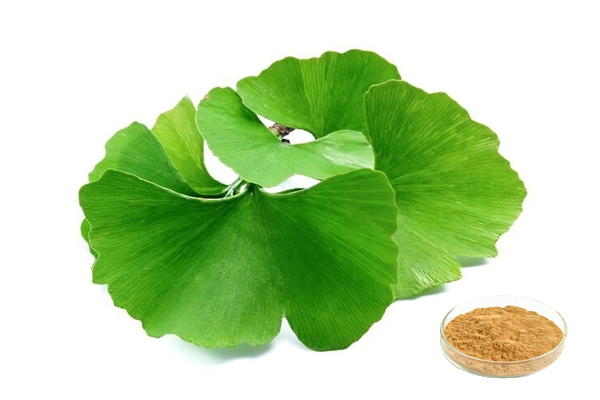
Latin Name: Ginkgo biloba L.
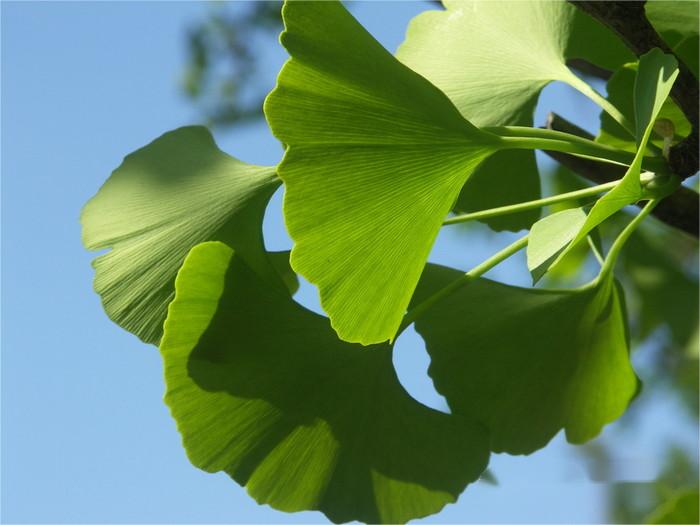
Plant Part Used: Ginkgo Biloba Leaf
Assay: Total Ginkgo Flavone Glycosides ≥ 24.0%, Total Terpene Lactones ≥ 6.0%
Testing Method: HPLC ;
Available Series: Standard Bulk Powder;Water-Soluble;Low-Acid Grade
Ginkgolic Acids: ≤ 5.0 ppm (USP/EP baseline) / ≤ 1.0 ppm (Ultra-low threshold) via RP-HPLC
Pesticide Residue: Compliant with maximum limits defined by EC No 396/2005yUSP <561>
Certificate: BRCGS, IFS, Organic (USDA/EU), Halal, Kosher
Sample: 10-50g Free Sample Available (For Lab R&D Testing)
- descripción
- Hoja de datos
-
Whatis Standardized Ginkgo Biloba Extract?
Standardized Ginkgo Biloba Extract is a plant-derived polyphenolicytrilactone matrix sourced from the dried leaves of Ginkgo biloba L. (Family: Ginkgaceae). As a specialized industrial supplier, Green Spring Technology processes this botanical raw material under strict analytical verification to ensure full compatibility with global pharmaceutical and dietary supplement sectors.
The botanical raw material yields ≥ 24.0% total ginkgo flavone glycosides (comprising Quercetin, Kaempferol, and Isorhamnetin) and ≥ 6.0% total terpene lactones (including Ginkgolides A, B, C, and Bilobalide) via HPLC. This precise chemical standardization satisfies current USP and EP monograph criteria, providing consistent active component bio-availability for international bulk distributions.
To meet strict cross-border compliance thresholds defined by USP <2232> and EC No 1881/2006, the extraction process incorporates targeted column separation. This technology limits cytotoxic ginkgolic acids to ≤ 1.0 ppm via RP-HPLC, successfully addressing critical safety benchmarks required during international customs clearance and regulatory audits.
The production facility operates under Food and Supplement Grade certifications, ensuring batch-to-batch chemical homogeneity across high-volume commercial campaigns. The resulting powder profile maintains an optimized particle distribution (100% through 80 mesh), enabling seamless integration into large-scale automated capsule filling, tableting, and dry-blend functional matrices.
especificación
Nombre del producto
Standardized Ginkgo Biloba Extract Powder
Nombre latino
Ginkgo biloba L.
CAS No.
90045-36-6
Plant Part Used
Ginkgo Biloba Leaf (en inglés)
Principios activos
Total Ginkgo Flavone Glycosides ≥ 24.0%; Total Terpene Lactones ≥ 6.0%
Available Series
Standard Bulk Powder; Water-Soluble Series; Low-Acid Series (Ginkgolic Acids ≤ 1.0 ppm)
Ginkgolic Acids ≤ 5.0 ppm (Standard EP/USP Compliance) / ≤ 1.0 ppm (Ultra-Low Grade) via RP-HPLC Método de ensayo
HPLC (Compliant with current USP and EP monograph criteria)
apariencia
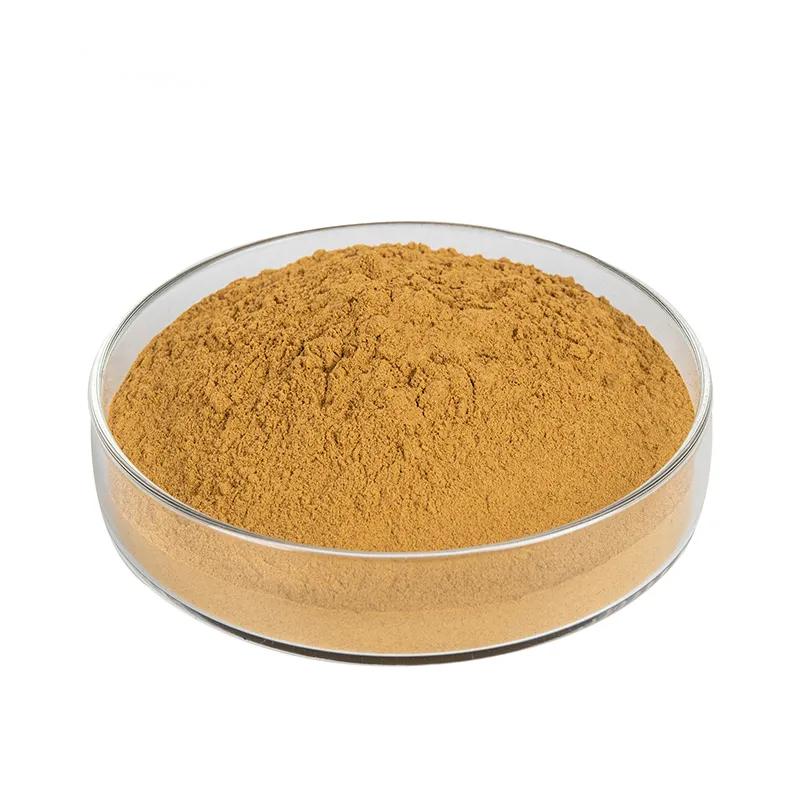
Polvo de color amarillo-marrón claro o marrón claro
Mesh Size 100% through 80 Mesh (180 μm) Loss on Drying ≤ 5.0% evaluated via USP <731> / EP 2.2.32 protocols at 105°C Heavy Metals Pb ≤ 1.0 ppm, As ≤ 1.0 ppm, Cd ≤ 0.5 ppm, Hg ≤ 0.1 ppm (Compliant with USP <2232> / EC No 1881/2006) Microbial Safety Total Plate Count ≤ 1,000 cfu/g; Yeast & Mold ≤ 100 cfu/g (Pathogens Negative via USP <2021/2022>) Residuos de plaguicidas
Compliant with current agricultural residue maximum limits defined by EC No 396/2005 and USP <561>
¿Busca un presupuesto?Póngase en contacto con nosotrosRequest a Custom QuoteQuality & Compliance
Contaminant Risk Mitigation: Strict compliance with EC No 396/2005 and USP <561> residue limits is maintained via systematic GC-MS/LC-MS-MS testing to exclude unauthorized pesticides.
Ginkgolic Acid Standardization: Multi-stage chromatography isolation maintains defined thresholds of Ginkgolic Acids ≤ 5.0 ppm (Standard Grade) or ≤ 1.0 ppm (Ultra-Low Grade) verified via RP-HPLC.
Elemental Impurities Monitoring: Heavy metals are regulated via ICP-MS to ensure strict adherence to USP <2232> and EC No 1881/2006 limits (Pb ≤ 1.0 ppm, As ≤ 1.0 ppm, Cd ≤ 0.5 ppm, Hg ≤ 0.1 ppm).
Global Certifications Grid: The manufacturing infrastructure of Green Spring Technology is audited and certified under BRCGS (Grade A), IFS (Higher Level), ISO 9001and ISO 22000.
Dietary & Organic Compliance: Product batches are verified and accompanied by Halal, Kosher, EU Organic, and USDA Organic certifications to satisfy international market access.
Third-Party Lab Validation: Random retention samples from every production lot undergo independent validation by accredited laboratories, including SGS and Eurofins, providing unbiased safety verification.
Regulatory Documentation Traceability: Actives are verified via HPLC. Every shipment includes a complete technical dossier, including batch-specific CoA, TDS, SDS/MSDS, Allergen-Free Statements, and Non-GMO Verification.

Key Advantages
Compressibility & Structural Uniformity: The calibrated micro-particulate morphology (100% through 80 mesh) undergoes direct compression matrices without requiring excessive binder volume, maintaining structural integrity and preventing localized active compound segregation during high-speed tableting operations.
Flowability & Mechanical Delivery: Low hygroscopicity profiles minimize capillary water absorption under standardized packaging environments, ensuring consistent mass flowability through automated capsule-filling hoppers and eliminating the risk of mechanical sticking or hopper bridging.
Chromatographic Toxin Resolution: Enforces specialized column separation to control cytotoxic markers according to ordered product series, providing validated Ginkgolic Acids ≤ 5.0 ppm (Standard Compliance) or ≤ 1.0 ppm (Ultra-Low Acid Grade) via RP-HPLC to satisfy specific cross-border market entry regulations.
Thermal & Compressive Resilience: Retains standardized chemical marker identities (≥ 24.0% Flavone Glycosides / ≥ 6.0% Terpene Lactones) without molecular cleavage, thermal degradation, or recrystallization when subjected to mechanical compression stress or core thermal processing profiles.
Traceable Unadulterated Profile: Manufactured using validated single-solvent ethanol extraction to eliminate raw material adulteration vectors, ensuring an unfortified botanical matrix that complies with corporate identity testing and transparency audits.
Applications
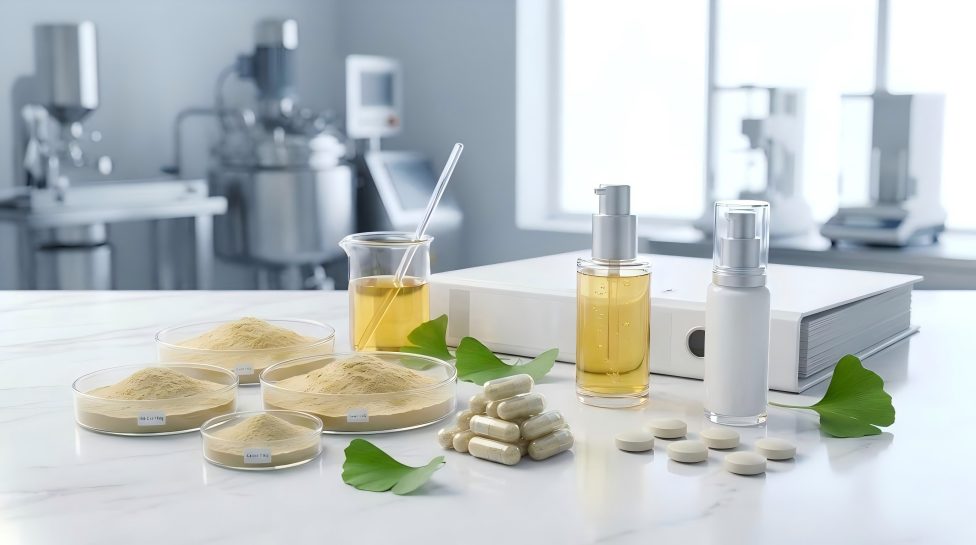
Automated Dietary Supplement Production: Calibrated as a high-density, low-hygroscopicity bulk powder for mechanical encapsulation and continuous high-speed tableting operations. The particle morphology ensures uniform mass flowability through automatic hoppers, limiting static tracking and preventing equipment clogging during long-run manufacturing campaigns.
Solid Functional Food Matrices: Incorporated as a standardized polyphenolic active within compressed nutrient bars, breakfast cereals, and extruded food bases. The active secondary metabolites (≥ 24.0% Flavone Glycosides / ≥ 6.0% Terpene Lactones) maintain thermal stability during standard industrial baking and heat extrusion profiles without molecular breakdown.
Dry Mix Powders & Ready-to-Drink Liquids: Specialized water-soluble series modifications within the product infrastructure allow for rapid dispersion in instant drink mixes and functional beverage lines. Utilizing the designated liquid-grade variant ensures predictable aqueous dispersion without raw material layer separation or macro-sediment drop-out under standard blending metrics.
Topical Personal Care Emulsions: Integrated into the aqueous or oil-in-water emulsion phases of adult personal care creams, protective lotions, and scalp formulations. Processing lots customized to the ultra-low toxic benchmark (Ginkgolic Acids ≤ 1.0 ppm) address chemical purity criteria required by international clean-label cosmetic regulatory matrices.
Technical FAQ
Q1: How does the HPLC chromatographic profile of Standardized Ginkgo Biloba Extract Powder satisfy current USP/EP authenticity validation to exclude botanical adulteration matrices?
A: Compliance with current USP and EP monographs requires mandatory HPLC-DAD and TLC fingerprinting on every production lot. The analytical process targets the specific peak ratio profiles of Quercetin, Kaempferol, and Isorhamnetin to verify that Total Ginkgo Flavone Glycosides remain ≥ 24.0%. Green Spring Technology implements high-resolution mass spectrometry screening to verify the complete absence of exogenous rutin, free quercetin, or Sophora japonica extract fortification, ensuring full traceability during corporate audits.Q2: What analytical instrumentation quantifies the 6% terpene lactones in USP/EP Compliant Ginkgo Leaf Extract to prevent the underestimation of specific sub-fractions?
A: Terpene lactones lack native ultraviolet chromophores, rendering conventional UV-Vis detection insufficient for pharmaceutical-grade quantification. Green Spring Technology standardizes this profile using High-Performance Liquid Chromatography paired with an Evaporative Light Scattering Detector (HPLC-ELSD) or LC-MS according to compendial protocols. This setup quantifies the independent molecular fractions—comprising Ginkgolides A, B, and C alongside Bilobalide—guaranteeing a genuine Total Terpene Lactones ≥ 6.0% threshold for formulation reproducibility.Q3: How is the physical color matrix of Standardized Ginkgo Biloba Leaf Extract stabilized against oxidative degradation during high-speed commercial dry blending lines?
A: Standardized polyphenolic glycosides are sensitive to continuous mechanical friction, localized kinetic heat, and ambient humidity, which can accelerate phenolic oxidation and trigger color shifting. The physical profile is stabilized by restricting the final moisture content to a verified threshold of Loss on Drying (LOD) ≤ 5.0% combined with nitrogen-purged hermetic protective packaging. Maintaining compounding environments at < 40% Relative Humidity (RH) and selecting low-shear dry blending parameters prevents mechanical stress degradation.Why Partner With Green Spring Technology?
Two-Decade Industrial Footprint: Established in 2000, Green Spring Technology functions as a validated botanical manufacturer and international B2B supplier, maintaining historical chemical traceability and multi-market supply chain execution for global health sectors.
In-House Analytical & Application Infrastructure: Operation of an independent R&D Laboratory equipped with high-resolution HPLC, GC-MS, and ICP-MS instrumentation supports active ingredient profile standardization and batch-specific chemical identity verification.
Formulation & Procurement Elasticity: Scalable production capacity allows for flexible MOQ options, supporting specialized pilot batches for contract development and manufacturing organizations (CDMO) alongside large-scale multinational commercial campaigns.
Pre-Evaluation Analytical Sampling: Formulation validation workflows are supported through 10g to 50g free samples, dispatched with standard technical dossiers including batch-specific CoA, TDS, and SDS/MSDS to accelerate laboratory testing.
Cross-Border Customs Clearance Engineering: Regulatory personnel provide complete customs compliance documentation, including certificates of geographical origin, non-irradiation declarations, and specific safety compliance metrics to streamline international port entry.
-
Download Data Sheet: COA, TDS, MSDS Please fill in the form below to receive the full technical documents via email.